No transcript available for this episode.
S01:E66
The Kettle War of 1784: The Bloodless Battle for the Scheldt
In the late eighteenth century, the geopolitical landscape of Europe was a powder keg of ancient rivalries, maritime ambitions, and fragile treaties. Yet, among the monumental clashes of the age, none began with such imperial bluster and ended in such farcical anti-climax as the confrontation on October 8, 1784, known to history as the Kettle War (in Dutch, the Keteloorlog). At its heart was a bitter commercial stranglehold, an ambitious Holy Roman Emperor, and an unassuming iron soup pot that unexpectedly took the brunt of international diplomacy.
For over a century, the once-bustling port of Antwerp had been choked into economic irrelevance. Under the 1648 Peace of Münster—part of the landmark Peace of Westphalia—the Dutch Republic had successfully secured the right to close the Western Scheldt River to ocean-going trade. By sealing this crucial artery to the North Sea, the Dutch systematically dismantled Antwerp’s commercial competition, channeling unimaginable wealth into their own merchant haven of Amsterdam. To the southern Netherlands, then under Austrian Habsburg rule, this enforced paralysis was a perpetual humiliation.
Enter Holy Roman Emperor Joseph II. A restless reformer and enlightened absolutist, Joseph was determined to modernize his dominions and unleash their economic potential. He viewed the Dutch closure of the Scheldt not as an unalterable pillar of international law, but as an outdated, predatory extortion. Emboldened by recent Dutch naval humiliations in the Fourth Anglo-Dutch War, Joseph demanded in 1784 the unconditional reopening of the river. The Dutch, fiercely protective of their maritime hegemony and sovereignty, flatly refused.
Refusing to back down, Joseph decided to test the Dutch resolve through provocative direct action. He ordered three merchant vessels under imperial colors to force the passage. The flagship of this modest flotilla was the armed brigantine ‘Le Louis’, commanded by Captain Philippe van Isseghem. Setting sail from Antwerp, ‘Le Louis’ crept cautiously down the winding waters of the Scheldt toward the open sea, flanked by the flat, misty pastures of Zeeland. A second imperial vessel prepared to enter the river from the opposite direction, testing the waters from the coast of Ostend.
As ‘Le Louis’ neared the bend at Saeftinghe, near the Dutch frontier, lookouts spotted an ominous silhouette cutting through the river fog. It was the ‘Dolfijn’, a heavily armed Dutch naval vessel commanded by Lieutenant Pieter Gerardus van Braam. The Dutch crew stood at action stations, matches burning, broadsides run out. Van Braam hailed the Austrian vessel and fired a blank warning shot into the air, signaling the imperial brig to drop anchor and turn back immediately.
Captain van Isseghem, bound by strict imperial orders to assert navigation rights without initiating bloodshed, held his course. The wind filled ‘Le Louis’s’ sails; the ship glided forward, breaching the forbidden boundary line. Onboard the ‘Dolfijn’, patience ran out. Lieutenant van Braam ordered his gunners to fire live ammunition.
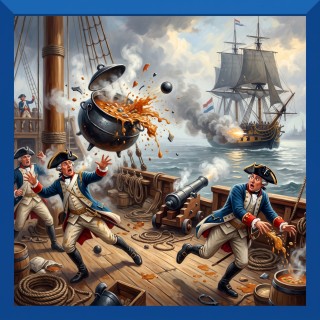
A deafening thunderclap ripped across the water as a Dutch cannon erupted in smoke and flame. The crew aboard ‘Le Louis’ braced for splintering wood, severed rigging, or horrific human carnage. Instead, the heavy iron ball whistled cleanly across the upper deck. With a loud, resonant clang, the projectile struck its solitary victim: a heavy iron cooking pot simmering with soup for the imperial crew. Shards of cast iron and boiling broth sprayed across the deck, drenching the startled sailors.
The strike proved entirely decisive. Seeing that the Dutch were willing to fire live rounds—and possessing neither the firepower nor the stomach for a suicidal shootout—Captain van Isseghem promptly hauled down his colors. Without a single drop of human blood spilled, ‘Le Louis’ surrendered on the spot.
When news of the culinary catastrophe reached European courts, Joseph II’s grand imperial defiance dissolved into universal laughter. Satirical pamphlets and caricatures flooded London, Paris, and Amsterdam, mercilessly mocking the emperor whose grand fleet was routed by the loss of a soup kettle. Realizing that a full-scale ground invasion of the Dutch Republic would trigger a catastrophic wider European conflict involving France and Prussia, Joseph backed away from the brink of war.
The dispute was formally concluded the following year with the Treaty of Fontainebleau (1785). Mediated by France, the treaty upheld Dutch control: the Scheldt remained firmly closed to international shipping. In exchange for saving face, the Austrian Habsburgs received a massive monetary compensation of nearly ten million guilders from the Dutch. The Scheldt would ultimately remain closed until the French Revolutionary armies swept across the Low Countries a decade later. Yet, in the annals of military history, the confrontation of 1784 secured an enduring legacy—a reminder that sometimes, the difference between an epochal war and international comedy is just one well-aimed cannonball hitting an iron soup pot.