S01:E58
The Last Universal Genius: Gottfried Wilhelm Leibniz and the Code of Reality
History rarely witnesses minds capable of mastering every frontier of human knowledge, but Gottfried Wilhelm Leibniz did not merely master his era—he anticipated the architecture of our modern world. Born in Leipzig in 1646, amidst the smoldering aftermath of the Thirty Years’ War, Leibniz emerged as the quintessential polymath. He was a mathematician, philosopher, diplomat, logician, engineer, historian, and theologian. In an age rapidly rushing toward extreme specialization, Leibniz was perhaps humanity’s last true universal genius: a thinker who believed that all knowledge was intrinsically interconnected, waiting to be unified into a single, harmonious system.
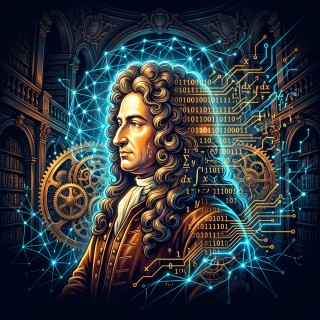
Leibniz’s life was propelled by an insatiable curiosity and an astonishingly productive intellect. In mathematics, his most celebrated achievement was the independent development of infinitesimal calculus. While Sir Isaac Newton had developed his own method of ‘fluxions’ in private seclusion, Leibniz devised calculus with an elegant, intuitive notation—introducing the elongated ‘S’ for integration (∫) and ‘d’ for differentials (dx). When Leibniz published his work in 1684, a bitter, nationalistic priority dispute erupted across the English Channel. The Royal Society, dominated by Newton, accused Leibniz of plagiarism. History, however, delivered vindication: Leibniz had arrived at his conclusions independently, and his notation proved so profoundly superior that it remains the universal language of mathematics, physics, and engineering today.
Yet calculus was only one facet of his visionary mind. Centuries before the invention of the microchip, Leibniz foresaw the digital age. Fascinated by the ancient Chinese philosophical text, the I Ching, Leibniz formalized the binary numeral system—the language of ones and zeros. He recognized that any logical premise or mathematical problem could be encoded using only two states: 0 and 1, representing nothingness and creation. Driven by the dream of mechanizing thought, he designed the ‘Stepped Reckoner’ (Staffelwalze), a mechanical calculator that was the first machine capable of performing all four basic arithmetic operations: addition, subtraction, multiplication, and division. He famously declared, ‘It is unworthy of excellent men to lose hours like slaves in the labor of calculation,’ foreseeing a future where machines would liberate the human spirit from routine labor.
In metaphysics, Leibniz constructed a worldview as intricate as a mechanical watch. In his groundbreaking work Monadology, he proposed that the universe is not composed of dead, material atoms, but rather of infinite, indivisible, non-physical centers of force and perception called ‘monads.’ Each monad acts as a living mirror of the entire cosmos, orchestrated in pre-established harmony by a divine creator. This metaphysical framework informed his optimistic theological masterpiece, the Theodicy. Confronting the timeless problem of evil, Leibniz argued through rigorous logic that God, possessing infinite wisdom and power, must have created the ‘best of all possible worlds.’ He maintained that what humans perceive as evil or suffering is merely a localized friction necessary for a greater, universal harmony—a concept later famously, if unfairly, satirized by Voltaire through the naive philosopher Pangloss in Candide.
Despite his staggering contributions, Leibniz spent much of his life working as a court counselor, librarian, and diplomatic mediator for the House of Hanover. He traveled tirelessly across Europe, attempting to bridge religious schisms between Protestants and Catholics, drafting plans for international academies of science, and designing wind pumps for the silver mines of the Harz mountains. When he died in 1716, his brilliance went largely uncelebrated by the Hanoverian court; only his personal secretary attended his burial. Today, however, Leibniz stands immortalized. From modern artificial intelligence and computer science to theoretical physics and modal logic, we still live in the intellectual universe that Gottfried Wilhelm Leibniz mapped out three centuries ago.