No transcript available for this episode.
S01:E105
The Madness of King Charles VI: A Shattered Reign
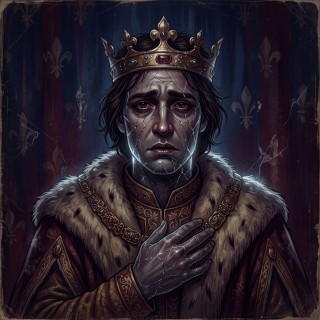
Imagine a monarch, ruler of one of Europe’s most powerful nations, living in constant terror that a sudden jolt, a clumsy servant, or even his own hurried movements could shatter him into a thousand pieces. This wasn’t a metaphor for the fragility of power, but the chilling reality for King Charles VI of France, known tragically as Charles the Mad. His reign, spanning from 1380 to 1422, was punctuated by prolonged bouts of severe mental illness, none more bizarre and heart-wrenching than his persistent delusion that he was made entirely of glass.
Born in 1368, Charles VI ascended the throne at a tender age, inheriting a kingdom embroiled in the Hundred Years’ War. Initially, he showed promise, displaying energy and a desire to govern effectively. However, the seeds of his future torment were sown in his early adulthood. The first major episode occurred in 1392, a terrifying incident known as the ‘Bal des Ardents’ or ‘Ball of the Burning Men.’ During a masquerade ball, Charles and five of his knights, disguised as wild men in highly flammable costumes, caught fire. Four of the men perished in agony, and though Charles survived, the trauma undeniably left a profound scar on his psyche.
Following this horrific event, Charles’s mental state rapidly deteriorated. His periods of lucidity became shorter, replaced by prolonged episodes of delusion and aggression. He would forget his identity, attack his own courtiers, and wander his palace in a disoriented state. But it was the ‘glass delusion’ that truly captured the imagination and pity of his contemporaries, and continues to fascinate historians and psychologists today. Charles genuinely believed his body was made of glass. He would wrap himself in thick padding, forbid anyone from touching him, and move with an agonizing slowness, terrified of breaking. He refused to allow himself to be handled, even by his closest attendants, for fear that a mere bump would cause him to splinter into countless shards.
This bizarre delusion wasn’t unique to Charles VI; historical records describe other individuals in medieval and early modern Europe suffering from similar convictions. What made Charles’s case so poignant was his position as king. His madness plunged France into political chaos. His queen, Isabeau of Bavaria, and his powerful uncles vied for control, leading to factionalism, civil war, and ultimately, the disastrous Treaty of Troyes in 1420, which disinherited his son and named King Henry V of England as heir to the French throne. The psychological fragility of their king directly translated into the political fragility of the nation.
Life at court became a delicate dance around the king’s delusions. Physicians were baffled, attempting treatments ranging from herbal remedies to more drastic measures. His closest advisors had to navigate his unpredictable moods and irrational fears. The image of a powerful monarch, draped in rich silks but internally convinced of his own brittle composition, is a stark and tragic one. He would often refuse to change clothes for weeks, fearing the movement would cause damage. His meals were a careful affair, presented with extreme caution.
While modern medicine can only speculate, many theories have been proposed for Charles VI’s condition. Some suggest porphyria, a genetic blood disorder known to cause neurological and psychological symptoms. Others point to encephalitis or bipolar disorder. The trauma of the ‘Bal des Ardents’ certainly acted as a powerful trigger, but the underlying vulnerability likely existed beforehand.
The story of Charles VI serves as a stark reminder of the human toll of mental illness, particularly when it afflicts those in positions of immense power. His reign, characterized by both military struggles and internal strife, was irrevocably shaped by his shattered mind. The king who believed he was glass eventually shattered France, leaving a legacy of both tragedy and enduring historical fascination. How can one reconcile the image of a formidable king with the reality of a man so utterly consumed by an internal world of imagined fragility? His tale forces us to confront the thin line between sanity and madness, even on the grandest stage of European royalty.