No transcript available for this episode.
S01:E102
The Night the Art Vanished: Unraveling the Isabella Stewart Gardner Museum Heist
The night of March 18, 1990, remains etched in the annals of art crime as one of the most audacious and perplexing heists in history. Two men, cloaked in Boston Police uniforms, approached the side entrance of the venerable Isabella Stewart Gardner Museum. They weren’t there to protect; they were there to plunder. What followed was an 81-minute ballet of theft, a meticulously executed operation that stripped the museum of thirteen priceless works of art, an estimated half-billion dollars worth of masterpieces, and left behind a void that 34 years later, still aches.
It began innocently enough, or so it seemed. The two guards on duty, Richard Abath and Randy Hestand, were accustomed to the quiet rhythm of the museum at night. When the ‘officers’ knocked, claiming to be investigating a disturbance, the guards, following protocol, allowed them entry. This was the first, and most crucial, misstep. Once inside, the charade crumbled. The ‘officers’ quickly subdued the guards, handcuffing them in the basement and securing them to pipes. No alarms were triggered, no shots fired, no immediate calls for help. The silence of the heist was as chilling as its audacity.
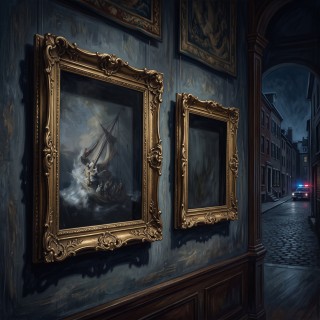
The thieves, displaying a curious blend of professionalism and seemingly arbitrary selections, then embarked on their spree. They bypassed the more valuable Titian, yet meticulously cut Rembrandt’s “The Storm on the Sea of Galilee” and “A Lady and Gentleman in Black” from their frames, leaving behind the empty canvases like gaping wounds. Vermeer’s sole seascape, “The Concert,” a work of unparalleled beauty and rarity, vanished. Manet’s “Chez Tortoni,” a delicate café scene, was also taken. Beyond these iconic pieces, they also stole several smaller, but historically significant, artifacts: a Chinese bronze gu, a finial from a Napoleonic flag, and drawings by Degas. The thieves weren’t indiscriminate, but their choices baffled experts for years. Was it a ‘shopping list’? Or a peculiar aesthetic?
The escape was as swift and clean as the entry. The thieves vanished into the pre-dawn Boston streets, taking with them not only the art but also the two video surveillance tapes, leaving investigators with scant physical evidence. The FBI launched an immediate and massive investigation, one that continues to this day, making it the largest unsolved art theft in history. Rewards were offered, initially a million dollars, later escalating to ten million, but the art remained elusive. Every lead, every tip, every whisper of a rumor has been pursued with unwavering determination, yet the masterpieces remain missing.
Over the decades, theories have proliferated. Was it the work of sophisticated organized crime, perhaps the Irish mob, with ties to Boston? Or an international ring of art traffickers? Some speculate about a local connection, suggesting the thieves had intimate knowledge of the museum’s layout and security protocols. Richard Abath, one of the guards, even faced scrutiny, though he was never charged and always maintained his innocence. The notion of a ‘perfect crime’ rarely holds true, but the Gardner heist comes perilously close.
The empty frames hanging in the museum’s Dutch Room serve as a poignant and perpetual reminder of the loss. They are not merely placeholders; they are monuments to an enduring mystery, a testament to the power of art to captivate and, in its absence, to haunt. The Isabella Stewart Gardner Museum, with its unique and intimate collection, has continued to thrive, but the ghost of those stolen masterpieces forever lingers, a silent plea for their return. The hope persists that one day, the truth will emerge, and these cultural treasures will once again grace the walls they were so violently ripped from, closing a chapter in a saga that continues to fascinate and frustrate in equal measure.