The Night the World Changed: The Incredible Fall of the Berlin Wall
Imagine waking up one morning to find a massive wall slicing right through your city. Overnight, your school, your favorite park, and even your friends and family on the other side are suddenly out of reach. Armed guards stand watch, and crossing the line could cost you your life. For the citizens of Berlin, Germany, this nightmare became a reality on August 13, 1961. For twenty-eight years, the Berlin Wall stood as a grim symbol of a divided world. But on one magical, chaotic night in November 1989, ordinary people did the impossible: they brought the Wall tumbling down.
To understand why the Wall was built, we have to travel back to the end of World War II. After Germany was defeated, the victorious Allied powers split the country into zones. The Western Allies (the USA, Great Britain, and France) controlled the western part, which became a free, capitalist democracy. The Soviet Union controlled the eastern part, turning it into a communist state. Berlin, the capital city, was located deep inside the communist territory, so it was also split into West and East Berlin.
As the years passed, life in democratic West Berlin flourished, while life in communist East Berlin grew increasingly difficult. People had little freedom of speech, and the government spied on its own citizens. Between 1949 and 1961, nearly three million East Germans fled to the West in search of a better life. Desperate to stop this massive brain drain, the East German government decided to block the exit. In the dead of night, soldiers began laying down barbed wire and concrete blocks. The Berlin Wall was born.
Over time, the barrier grew into a terrifying complex of two concrete walls separated by a heavily guarded area known as the “death strip.” This strip was filled with landmines, tripwires, vicious guard dogs, searchlights, and armed soldiers who had orders to shoot anyone trying to escape. Despite the danger, people tried incredible, daring escapes. Some dug deep tunnels under the Wall, others built homemade hot air balloons, and a few even drove heavily armored cars straight through the checkpoints! Tragically, at least 140 people lost their lives trying to cross.
By the late 1980s, the winds of change began to blow. The Soviet leader, Mikhail Gorbachev, started introducing reforms that allowed more freedom. Inspired by this, citizens in neighboring countries like Poland and Hungary began demanding democracy. In East Germany, hundreds of thousands of brave people took to the streets in peaceful protests, chanting “Wir sind das Volk” (We are the people). The communist government was losing its grip and realized they had to make some concessions to keep the peace.
On the evening of November 9, 1989, an East German official named Günter Schabowski held a live, televised press conference to announce a new policy: East Germans would be allowed to travel to the West with proper permission. But there was a massive mix-up. Schabowski hadn’t read the details of the plan before the press conference. When a reporter asked him when these new travel rules would take effect, Schabowski shuffled his papers, looked confused, and replied: “As far as I know, this enters into force… immediately, without delay.”
In reality, the law was supposed to start the next morning to give border guards time to prepare. But the news spread like wildfire. Within minutes, thousands of ecstatic East Berliners rushed to the border checkpoints. The guards at the Bornholmer Straße crossing were completely overwhelmed. They tried to call their bosses for orders, but nobody knew what to do. The crowd grew larger, louder, and more determined, chanting, “Open the gate!”
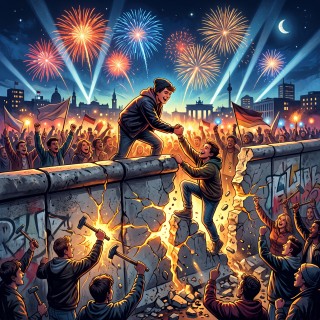
Finally, around 11:30 PM, the chief officer at the checkpoint made a historic decision. Rather than risking violence, he ordered his men to open the barriers. East Berliners flooded through, where they were met by cheering West Berliners who handed them flowers, chocolate, and sparkling wine. People climbed on top of the Wall, dancing and singing in the searchlights. Ordinary citizens, nicknamed “Mauerspechte” (Wall peckers), brought out hammers and chisels to chip away chunks of the concrete barrier.
The Berlin Wall, which had divided families and symbolized the Cold War for decades, had fallen without a single shot being fired. Less than a year later, Germany was officially reunited. Today, only a few painted sections of the Wall remain as a reminder of a dark time and a testament to the power of ordinary people who dared to dream of freedom.