0:00Intro
The Phantom Vanguard: How the Ghost Army Deceived the Third Reich
In the chaotic summer of 1944, as Allied forces fought their way across Western Europe, the German High Command found itself repeatedly outmaneuvered by an elusive, ghostlike adversary. Nazi reconnaissance planes would spot an entire armored division assembling near a strategic river crossing, complete with the rumble of hundreds of tank engines and heavy radio traffic. German generals would scramble their elite panzers and artillery to intercept the threat, only to discover an empty forest. The phantom division had vanished into thin air, leaving the actual Allied strike force to break through an undefended flank miles away.
This was not sorcery; it was the masterpiece of the 23rd Headquarters Special Troops—a top-secret, 1,100-man unit known to history as the Ghost Army. Unlike traditional combat battalions filled with infantrymen and artillery gunners, this extraordinary unit was largely composed of creative minds handpicked from American art schools, design studios, advertising agencies, and radio networks. Among their ranks were future luminaries of American culture, including fashion designer Bill Blass, painter Ellsworth Kelly, wildlife artist Arthur Singer, and photographer Art Kane. Their mission was singular, audacious, and unprecedented in modern warfare: to wage war through pure illusion.
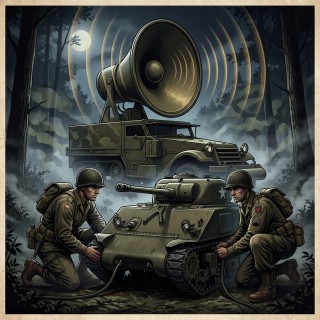
The Ghost Army’s toolkit was divided into four interconnected disciplines of deception: visual, sonic, radio, and atmospheric. The visual component relied heavily on high-grade inflatable rubber dummies manufactured by the Goodyear Tire & Rubber Company. In a matter of twenty minutes, soldiers wielding air compressors could inflate an entire phantom battalion of M4 Sherman tanks, artillery howitzers, ammunition trucks, and spotter planes. To make the illusion convincing from both the air and ground, artists painted realistic weathering, rust, and mud onto the rubber skins. Soldiers dragged heavy iron rails behind bulldozers to carve authentic tank tracks into the mud, meticulously concealing the fact that a pair of men could easily lift a two-ton ‘Sherman’ by its canvas frame.
Visuals alone, however, were not enough to fool seasoned German scouts. To give their inflatable armor life, the unit employed sonic deception. Engineers from Bell Laboratories had journeyed to Fort Knox to record the sounds of various military activities onto state-of-the-art wire recorders—capturing the distinct acoustic signatures of tank convoys, infantry marching in mud, and engineers frantically assembling pontoon bridges. On the front lines, half-tracks equipped with massive 500-pound directional speakers and 100-watt amplifiers blasted these audio mixes into the foggy European nights. With a range of up to fifteen miles, the soundscapes were so convincing that even nearby American soldiers frequently believed an entire armored corps was rolling past in the dark.
Meanwhile, the unit’s signal corps executed ‘spoof radio.’ Radio operators meticulously studied the unique ‘fist’—the distinct rhythm and tapping cadence—of telegraph operators in real divisions. By mimicking these styles and broadcasting intricate webs of fake Morse code, logistical chatter, and command orders, they painted a false picture for German radio interception teams, confirming the presence of massive forces where none existed.
Finally, the troops engaged in ‘atmosphere’—the art of tactical acting. Ghost Army soldiers would wander into local French or Belgian taverns wearing the shoulder patches of real, celebrated divisions. They openly planted rumors of incoming offensives, knowing that Nazi sympathizers and double agents were listening. Officers drove marked command jeeps back and forth through villages to create the impression of a bustling divisional headquarters.
The Ghost Army conducted over twenty deception operations across France, Belgium, Luxembourg, and Germany. Their crowning achievement came in March 1945 during Operation Viersen along the Rhine River. Pretending to be the 30th and 79th Infantry Divisions, the Ghost Army drew German defenders away from the actual crossing point of the U.S. Ninth Army, enabling the real assault force to cross the Rhine with astonishingly low casualties.
For more than fifty years, the exploits of the Ghost Army remained classified. The men went home, swore an oath of silence, and resumed their artistic careers without ever receiving public credit. It was not until the files were declassified in 1996 that their astonishing heroism came to light. By wielding paintbrushes, speakers, and rubber instead of bullets, the Ghost Army saved an estimated 15,000 to 30,000 Allied lives—proving that in the crucible of war, intellect and creativity can be the most devastating weapons of all.