
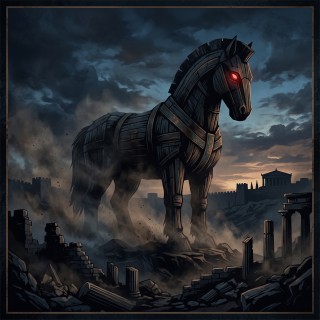
The Real Story of the Trojan Horse: Wooden Deception or Metaphorical Might?
For millennia, the tale of the Trojan Horse has captivated imaginations, a story of cunning, courage, and ultimate destruction. Homer’s epic, ‘The Odyssey,’ paints a vivid picture of a colossal wooden horse, a ‘sacred offering’ left by the retreating Achaeans, concealing a stealthy commando unit that would ultimately breach Troy’s impenetrable walls. But beyond the myth, what is the real story of this legendary siege engine? Was it truly a masterful feat of carpentry and subterfuge, or merely a poetic embellishment, a metaphor for a different, equally devastating, ancient weapon?
The traditional narrative is deeply ingrained in our collective consciousness. After a decade of fruitless siege, the Achaeans, led by the cunning Odysseus, concocted a desperate plan. They built an enormous wooden horse, hollowed out to hide their elite warriors. Pretending to abandon the siege, they sailed away, leaving behind Sinon, a persuasive actor, to convince the Trojans that the horse was an offering to Athena, intended to secure a safe return voyage for the Greeks. Despite the warnings of Laocoön and Cassandra, the Trojans, euphoric at the apparent end of the war, dragged the massive effigy inside their city walls. That night, as Troy celebrated, the hidden Greeks emerged, opened the city gates, and allowed the returning Achaean army to pour in, leading to the city’s sacking and ultimate downfall.
This account is undeniably compelling. The sheer audacity of the plan, the psychological warfare employed, and the tragic hubris of the Trojans make for a timeless drama. However, archeologists and historians, ever skeptical of purely mythological accounts, have long questioned the literal interpretation of the wooden horse. The logistical challenges alone of building such a structure on a battlefield, moving it, and concealing a significant number of heavily armed men within it, without detection, are immense.
One prominent alternative theory suggests that the ‘Trojan Horse’ was, in fact, an ancient battering ram. Imagine a siege engine, perhaps covered in wet horse hides (to prevent burning), designed with a massive, horse-shaped head at its striking end. Such a device would be crucial for breaching fortifications, symbolizing strength and unstoppable force. The metaphor of a horse, representing power and an instrument of war, is readily apparent in many ancient cultures. The description of the horse being ‘dragged’ into the city could easily refer to the strenuous effort required to maneuver such a heavy siege weapon. The ‘men inside’ could then be the specialized crew operating the battering ram, who, once a breach was made, would be the first to enter the city, effectively ‘opening the gates’ for the main army.
Another intriguing hypothesis posits that the ‘horse’ could have been a seismic event, an earthquake, which was often attributed to Poseidon, the ‘Earth-Shaker.’ A significant tremor could have weakened or even breached Troy’s walls, allowing the Achaeans to finally overrun the city. The Greeks, eager to claim victory through their own ingenuity rather than a natural disaster, might have spun a tale of a magical horse to glorify their achievement.
Furthermore, some scholars propose that the ‘Trojan Horse’ was a sophisticated naval vessel. The term ‘horse’ was sometimes used to describe ships, especially those with elaborate figureheads. If the Achaeans had ships capable of approaching the city walls, perhaps through a river or a clever naval maneuver, and discharging troops directly into the city, the myth could be a poetic rendering of such a military operation. This would align with the Achaean’s known naval prowess.
The historical and archaeological evidence regarding Troy itself is complex. Excavations by Heinrich Schliemann and later researchers have revealed multiple layers of occupation, with Troy VIIa being the most likely candidate for Homeric Troy, showing signs of destruction by fire and warfare around 1250 BCE. While these findings confirm the existence of a mighty city and a violent end, they offer no definitive proof of a giant wooden horse.
Ultimately, the enduring mystery of the Trojan Horse lies in its ambiguity. Whether a literal masterpiece of deception or a powerful metaphor for a sophisticated siege engine, a natural disaster, or even a specialized ship, the story serves as a potent reminder of the human capacity for innovation, trickery, and the devastating consequences of war. The ‘real story’ might forever remain shrouded in the mists of time, but its power to inspire wonder and debate is undiminished, cementing its place as one of history’s most compelling enigmas.