No transcript available for this episode.
S01:E79
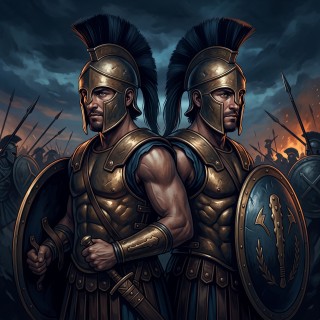
The Sacred Band of Thebes: Unbreakable Bonds, Undefeated Warriors
In the annals of military history, tales of legendary units often revolve around their unwavering discipline, brutal training, or technological superiority. Yet, one ancient Greek fighting force stands apart, not merely for its tactical brilliance or unparalleled success, but for the very fabric of its composition: the Sacred Band of Thebes. This elite corps, forged in the crucible of love and devotion, consisted entirely of 150 pairs of deeply committed male lovers, their bond an unbreakable shield and an unstoppable sword on the battlefield.
Formed around 378 BC, during a period of intense political and military upheaval in Greece, the Sacred Band was a radical departure from conventional military organization. While other city-states relied on citizen militias or mercenary forces, Thebes, under the visionary leadership of commanders like Pelopidas and Epaminondas, recognized a potent, untapped source of motivation: Eros. The belief was simple yet profound: men would fight more fiercely, risk more bravely, and protect each other more resolutely when their lives were intertwined by love, not just duty or camaraderie. Plato, in his Symposium, eloquently articulated this principle, suggesting that ‘a whole army of lovers and their beloveds, fighting at each other’s side, though a mere handful, would conquer the world.’ The Sacred Band was the embodiment of this philosophy.
The pairs were meticulously chosen, with each older, more experienced lover (the ‘erastes’) mentoring and inspiring his younger, beloved counterpart (the ‘eromenos’). This dynamic fostered an extraordinary level of trust and interdependence. On the battlefield, they were not just soldiers; they were guardians of each other’s honor, life, and love. The thought of appearing cowardly or failing one’s beloved in battle was a far greater deterrent than any military punishment. This emotional intensity translated directly into unparalleled ferocity. They fought as one, their movements synchronized, their wills unified by a common, deeply personal stake in victory.
Their training was as rigorous as their commitment was deep. Stationed in the Cadmea, the citadel of Thebes, they underwent continuous physical and martial conditioning. But it was their psychological preparation, rooted in their unique interpersonal dynamics, that truly set them apart. They learned to anticipate each other’s moves, to communicate without words, and to draw strength from their shared vulnerability and devotion. Their enemies, accustomed to the more detached combat of regular armies, were often psychologically unprepared for the sheer intensity and cohesiveness of the Sacred Band’s attacks.
The Sacred Band’s legend was forged in a series of decisive victories that dramatically shifted the balance of power in Greece. Their most famous triumph came at the Battle of Leuctra in 371 BC, where they played a pivotal role in the Theban army’s stunning defeat of the seemingly invincible Spartan phalanx. This battle marked the beginning of Theban hegemony and shattered Sparta’s long-held military supremacy. Later, at the Battle of Mantinea in 362 BC, they once again proved their mettle, though this victory was overshadowed by the death of Epaminondas.
For over three decades, the Sacred Band remained undefeated, a living testament to the power of love in war. Their reputation was so fearsome that their very presence on the battlefield could demoralize opposing forces. They were the ultimate shock troops, capable of breaking enemy lines and turning the tide of battle with their coordinated charges and unbreakable spirit. However, even the most legendary forces eventually meet their match. Their end came brutally and heroically at the Battle of Chaeronea in 338 BC. Facing the formidable Macedonian army led by Philip II and his son Alexander, the Sacred Band fought with their customary valor. Despite being outnumbered and ultimately surrounded, they refused to break formation or surrender. They fell where they stood, every pair fighting to the last, their bodies found interlocked on the battlefield, a testament to their unwavering loyalty even in death.
Philip II, upon surveying the carnage and realizing the true nature of the fallen warriors, is said to have wept, declaring, ‘Perish any man who suspects that these men did or suffered anything base.’ The Sacred Band of Thebes remains an enduring symbol of courage, devotion, and the profound, often unexpected, ways in which human bonds can shape the course of history. Their legacy challenges conventional notions of military might, reminding us that the most potent weapons are sometimes forged not of steel, but of the human heart.