S01:E39
The Scourge and the Architect: The Untold Rise of Genghis Khan
Out of the frozen, unforgiving expanse of the 12th-century Eurasian steppe emerged a force that would permanently redraw the map of the known world. Before he became Genghis Khan—the ‘Universal Ruler’ whose name struck terror and awe across continents—he was merely Temüjin, a boy born into a world of relentless clan violence, betrayal, and raw survival against all odds. Born around 1162 with a dark blood clot clutched in his tiny fist, legend says ancient shamanic tradition interpreted this as a sacred sign of a warrior destined to rule. Yet, his early life was marked not by royal privilege, but by extreme tragedy.
When Temüjin was just nine years old, his father, a minor chieftain, was fatally poisoned by rival Tatars. Cast out and abandoned by their own clan who deemed them too weak to survive, Temüjin, his formidable mother Hoelun, and his siblings were left to starve in the brutal wilderness. They survived by hunting small game, foraging roots, and constantly evading slave raiders. This crucible of hardship forged in young Temüjin an iron willpower and an acute understanding of human motivation. He realized that on the steppe, survival required absolute loyalty, calculated pragmatism, and unflinching resolve.
Through strategic alliances, blood brotherhoods, and daring military maneuvers, Temüjin began uniting the fractured, fiercely independent nomadic tribes of Mongolia. Unlike traditional steppic chieftains who rewarded only aristocratic kin, Temüjin broke centuries of tribal custom by instituting a strict meritocracy. He promoted commanders based on skill, courage, and unwavering loyalty rather than noble lineage. Furthermore, he integrated conquered soldiers directly into his own ranks instead of enslaving them, weaving disparate tribes into a single, loyal brotherhood. By 1206, at a monumental national assembly known as a Kurultai, the unified nomadic nations proclaimed him Genghis Khan.
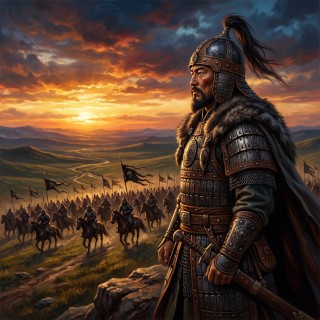
With a unified army behind him, Genghis Khan turned his vision outward, initiating one of the most astonishing expansion campaigns in human history. The Mongol war machine was defined by unprecedented speed, discipline, and psychological warfare. Riding sturdy, highly adaptable Mongolian horses, every soldier was a master equestrian and archer, capable of firing lethal compound bows with pinpoint accuracy at full gallop. Genghis Khan perfected devastating tactics, such as the feigned retreat, luring overconfident enemy armies into carefully prepared kill zones.
His military brilliance was complemented by an astonishing communication network. The ‘Yam’ system—a vast web of postal relay stations equipped with fresh horses and dedicated couriers—allowed messages, orders, and intelligence to travel thousands of miles across mountains and deserts in mere days. News of enemy movements reached Genghis Khan far faster than any monarch of his era could dream.
When diplomatic envoys sent to the wealthy Khwarazmian Empire in Central Asia were executed and humiliated by local rulers, Genghis Khan unleashed a wave of calculated retribution. Cities that resisted were dismantled with terrifying efficiency using advanced siege machinery adapted from captured engineers. Yet, beneath the fearsome reputation for destruction lay a complex, remarkably modern administrator.
Genghis Khan ushered in the Pax Mongolica, a period of unprecedented peace and international connectivity across Eurasia. Under his rule, the Silk Road flourished like never before, heavily guarded against bandits to ensure safe passage for merchants. He created a unified legal code known as the Yassa, exempted religious leaders from taxation, and enforced total religious freedom across his vast dominions—a radical policy for the 13th century. Scholars, artisans, and merchants from Christian, Islamic, Buddhist, and Taoist traditions traveled freely, transforming the empire into a melting pot of global trade and cultural exchange.
When Genghis Khan died in 1227 during a campaign against the Western Xia, he left behind an empire stretching from the Sea of Japan to the borders of Eastern Europe. According to his final wishes, he was buried in an unmarked grave deep in the sacred Mongolian wilderness, his resting place deliberately shrouded in mystery to this day. Genghis Khan was far more than a bloodthirsty conqueror; he was a master strategist, an innovator, and a catalyst for global connectivity whose legacy reshaped human civilization forever.