
0:00Intro
The Sweet Accident of Science: Percy Spencer and the Birth of the Microwave Oven
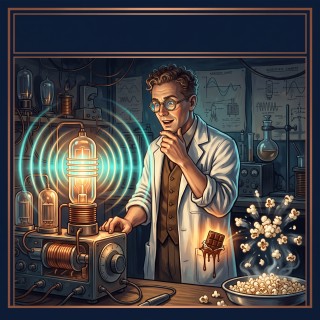
On a crisp afternoon in 1945 inside a bustling Raytheon laboratory in Waltham, Massachusetts, an unassuming engineer named Percy Spencer stopped dead in his tracks. He was standing in front of an active cavity magnetron—a high-powered vacuum tube designed to emit short radio waves for military radar systems. Spencer was no stranger to high technology, but what happened next had nothing to do with spotting enemy fighter planes. Reaching casually into his trousers, he felt a warm, sticky sludge where a solid chocolate peanut cluster bar should have been. It had completely liquefied in his pocket without burning his skin.
For most people, a melted candy bar would have elicited nothing more than a sigh of frustration and a trip to the dry cleaner. For Percy Spencer, it was a spark that ignited one of the greatest accidental revolutions in modern culinary history.
Spencer’s path to this transformative moment was anything but conventional. Orphaned as a toddler in rural Maine and left with little formal schooling, he left school at the age of twelve to work in a spool mill. Yet, possessed by an unquenchable curiosity, he taught himself advanced trigonometry, physics, metallurgy, and chemistry by lantern light. When wireless radio emerged as a revolutionary technology, Spencer mastered it. By the height of World War II, he was widely regarded as Raytheon’s top problem-solver, single-handedly discovering mass-production techniques that skyrocketed magnetron output from 17 units a day to over 2,600, earning praise from the United States Navy for shifting the tides of Allied radar capabilities.
Standing in that laboratory, Spencer’s brilliant mind immediately deduced what had occurred. The magnetron’s high-frequency electromagnetic waves—microwaves—were penetrating the chocolate and causing its polar molecules, particularly water and fat, to vibrate frantically. This friction generated intense, localized heat almost instantaneously from the inside out.
Fascinated, Spencer decided to test his hypothesis. He dispatched a lab assistant to fetch a bag of unpopped corn kernels. Placing the dried kernels directly in front of the magnetron’s horn antenna, the engineers stepped back. Within moments, the laboratory filled with rapid-fire popping sounds as white kernels burst violently across the worktable. For the first time in human history, food had been deliberately cooked using microwave radiation.
The following morning, Spencer escalated the experiment with a raw, uncracked egg. He placed it inside a makeshift metal kettle and aimed the microwave beam directly at it. A skeptical colleague leaned over the rim to inspect the progress just as the internal steam pressure reached critical mass. The egg detonated with tremendous force, splattering scorching yolk and albumen across the engineer’s face. It was a messy, startling confirmation: microwave energy could heat organic matter with astonishing speed and immense internal power.
Recognizing the commercial potential, Spencer and Raytheon immediately set to work designing a safe, practical enclosure. Since metal surfaces reflect microwaves rather than absorb them, Spencer enclosed the magnetron inside a sealed metallic box. The waves bounced off the walls continuously, creating a dense, localized energy field that cooked food uniformly and safely without leaking hazardous radiation into the room.
In 1947, Raytheon patented the technology and introduced the world’s first commercial microwave oven: the ‘Radarange.’ Standing nearly six feet tall, weighing roughly 750 pounds, water-cooled, and costing thousands of dollars, it was a far cry from modern countertop appliances. It was initially purchased only by ocean liners, luxury trains, and large institutions. Yet, over the subsequent decades, the technology was refined, downsized, and transformed into an indispensable staple found in billions of homes worldwide.
Percy Spencer received only a nominal two-dollar bonus from Raytheon for the patent—the standard token payment for corporate inventors at the time—but his legacy became monumental. His insatiable curiosity and observant eye turned a ruined pair of pants into an everyday miracle of science that fundamentally reshaped how the world eats.