S01:E117
The Sweetest Revenge: France’s Pastry War (1838)
Imagine a world where a baker’s ruined shop could spark an international conflict, where the crunch of broken glass led to the booming of cannons. This isn’t a whimsical tale from a children’s book; this is the astonishing, and frankly, delicious, true story of the Pastry War of 1838, a conflict that saw France invade Mexico over a pastry chef’s vandalized bakery.
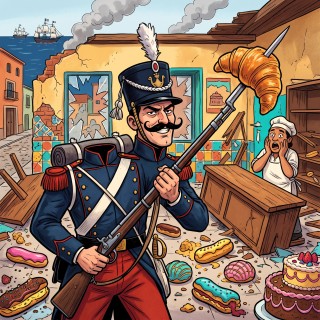
The year is 1838. Mexico, having only recently gained independence from Spain, was a young nation grappling with internal instability and a chaotic political landscape. Revolts and coups were frequent, and with them came a breakdown of law and order. One unfortunate casualty of this tumult was a French pastry chef named Monsieur Remontel, who owned a beloved bakery in Tacubaya, a district of Mexico City. During a period of widespread unrest and looting, some rowdy Mexican soldiers, in a moment of utter disregard for delicate éclairs and crispy croissants, ransacked Remontel’s establishment. They didn’t just smash a window; they went through the shop like a hurricane of hungry, destructive soldiers, leaving behind a trail of shattered crockery, demolished display cases, and, presumably, a great many crumbs.
Now, you might think, ‘Bad luck, Monsieur Remontel. File an insurance claim.’ But this was a different era, and Remontel was a Frenchman in a foreign land. He appealed to his government, seeking compensation for the considerable damage to his livelihood. The French government, under King Louis-Philippe I, saw an opportunity. They had numerous complaints from French citizens residing in Mexico who had suffered losses due to the ongoing instability. These claims, collectively known as ‘French claims for damages,’ had largely gone unaddressed by the Mexican government, which was perpetually short on funds and preoccupied with its own internal struggles.
The specific demand for Monsieur Remontel’s ruined bakery, among other grievances, escalated quickly. France presented Mexico with an ultimatum: pay 600,000 pesos in compensation, or face the consequences. To put this sum into perspective, 600,000 pesos was an astronomical amount for the fledgling Mexican nation. It was roughly equivalent to a substantial portion of Mexico’s annual revenue at the time. Mexico, perhaps understandably, refused to pay what they considered an extortionate demand, especially one stemming from such a seemingly trivial incident.
Enter the French Navy. King Louis-Philippe, eager to assert French power and protect French interests abroad, dispatched a fleet under the command of Rear Admiral Charles Baudin. In October 1838, Baudin’s squadron arrived off the coast of Veracruz, Mexico’s principal port. The stage was set for a conflict that would forever be known as the ‘Pastry War,’ or the ‘Guerra de los Pasteles’ in Spanish.
The French initiated a blockade of Mexican ports, severely disrupting trade and crippling the Mexican economy. When Mexico continued to resist, the French took more direct action. On November 27, 1838, the French bombarded the fortress of San Juan de Ulúa, which guarded the harbor of Veracruz. After a fierce battle, the fortress fell, and the city of Veracruz was occupied by French forces. This was a significant blow to Mexican pride and sovereignty.
The conflict wasn’t just a naval affair. Mexican forces, led by figures such as General Antonio López de Santa Anna (a name that would become infamous in Mexican history, particularly during the Texas Revolution and the Mexican-American War), attempted to repel the French. Santa Anna, despite having lost a leg previously, personally led troops into battle against the French, demonstrating a characteristic blend of bravery and recklessness.
The Pastry War drew international attention. Great Britain, ever keen to maintain a balance of power in the region and protect its own commercial interests, intervened diplomatically. Their mediation efforts, led by Commodore Richard Pakenham, eventually brought the conflict to an end. In March 1839, a peace treaty was signed, with Mexico agreeing to pay the demanded 600,000 pesos. The French lifted their blockade and withdrew their forces. The war, which had lasted a mere four months, had cost Mexico dearly, both in terms of financial strain and human lives.
What are the lasting lessons from this bizarre conflict? It highlights the fragility of sovereignty in a post-colonial world, the often-disproportionate use of force by powerful nations, and the strange ways in which seemingly minor incidents can escalate into major international crises. It also underscores the economic vulnerability of nations and the power dynamics that shape global relations. And perhaps, it serves as a quirky reminder that sometimes, even a ruined pastry shop can become a symbol of national honor and a catalyst for war.
So, the next time you enjoy a delicate croissant or a rich chocolate éclair, spare a thought for Monsieur Remontel and the audacious French invasion that followed the destruction of his bakery. It’s a sweet, albeit violent, chapter in the annals of history.
Questions for Reflection: