0:00Intro
The Three Hundred and Thirty-Five Years’ War: The Longest, Laziest, and Most Bloodless Conflict in History
Imagine a war that lasted longer than the entire lifespan of many nations, a conflict that spanned centuries, yet resulted in not a single drop of blood spilled, no property destroyed, and no animosity fostered. This isn’t a whimsical tale from a forgotten fable; it’s the bizarre, true story of the Three Hundred and Thirty-Five Years’ War, a peculiar historical footnote that stands as a testament to diplomatic oversight, geographical isolation, and perhaps, a touch of British eccentricity.
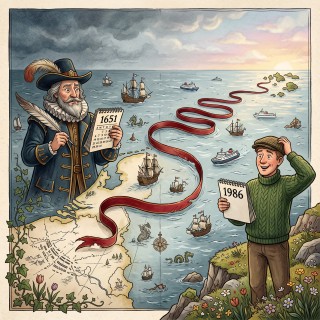
Our story begins not with a bang, but with a whimper, or rather, a declaration of war that was promptly forgotten. The year is 1651. England is in the throes of its brutal Civil War. The Royalist fleet, under the command of Prince Rupert, sought refuge in the Isles of Scilly, a small archipelago off the southwestern coast of Cornwall. Parliamentarian forces, eager to quash any remnants of royalist resistance, sent a Dutch fleet, led by Admiral Maarten Harpertszoon Tromp, to blockade the islands. The Dutch, having suffered significant losses to Royalist privateers operating from Scilly, demanded reparations. When these were not forthcoming, Tromp, on April 30, 1651, declared war on the Isles of Scilly – not on England as a whole, but specifically on this tiny cluster of islands, which were then still a Royalist stronghold. This declaration, though perfectly legitimate under the laws of war at the time, was largely symbolic and intended to pressure the Royalists. With the subsequent Royalist surrender on Scilly just a few weeks later, the immediate cause for the Dutch declaration vanished. The English Civil War concluded shortly thereafter, and the Dutch, having secured their primary objective against the Royalists, simply sailed away.
And then, nothing. For three hundred and thirty-five years. The declaration of war, a fleeting moment in the grand tapestry of European conflict, was simply never officially rescinded. It languished in the dusty annals of history, a forgotten diplomatic technicality. The Netherlands and the United Kingdom (which by then had absorbed the Scilly Isles) maintained amicable relations, traded, allied in other conflicts, and generally behaved as two friendly nations should. The residents of Scilly went about their lives, blissfully unaware they were technically at war with a major European power. The Dutch, equally oblivious, focused on global trade and colonial expansion.
It wasn’t until 1985 that the colossal oversight was finally brought to light. Roy Duncan, a Scillonian historian and Chairman of the Scilly Council, stumbled upon the forgotten declaration during his research. Intrigued by this historical oddity, he contacted the Dutch Embassy in London. To their immense surprise and amusement, the Dutch government confirmed that, indeed, no peace treaty had ever been signed. Technically, they were still at war with the Isles of Scilly. The situation was, as one might imagine, a source of considerable mirth and a unique opportunity for diplomatic good humor.
On April 17, 1986, Lieutenant Commander R.G. de Groot, the Dutch Ambassador to the United Kingdom, made a ceremonial visit to the Isles of Scilly. There, to the delight of the islanders and the world’s press, he signed a peace treaty, officially ending the Three Hundred and Thirty-Five Years’ War. The signing ceremony, far from being a somber affair, was a joyous occasion, complete with fireworks and a celebratory atmosphere. Ambassador de Groot humorously remarked that the people of Scilly must have been ‘terribly relieved’ to finally be at peace. The war, which had never seen a shot fired, a life lost, or a property damaged, concluded in a fittingly cordial and bloodless manner.
The Three Hundred and Thirty-Five Years’ War serves as a fascinating historical anomaly, a whimsical anecdote that highlights the absurdities that can arise from diplomatic inertia. It’s a powerful reminder that sometimes, the greatest conflicts are the ones that never actually happen, and the longest wars are those that are simply forgotten. It stands as a unique testament to peace by omission, a conflict so utterly benign that its very existence was a surprise to all involved. It remains, to this day, the longest recorded ‘war’ in history, a truly forgotten bloodless conflict that finally found its peaceful, albeit belated, resolution.