No transcript available for this episode.
S01:E119
The Tinderbox of Europe: Unraveling the Causes and Lessons of World War I
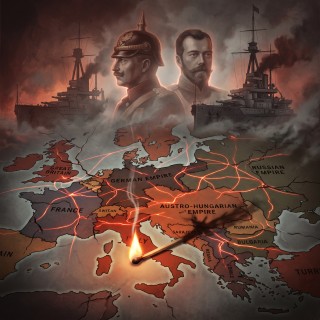
The assassination of Archduke Franz Ferdinand on June 28, 1914, in Sarajevo is often cited as the spark that ignited World War I. While undeniably a critical trigger, it was merely the match dropped into a tinderbox meticulously assembled over decades by geopolitical tensions, shifting alliances, fervent nationalism, and an arms race of unprecedented scale. To truly understand ‘Wie kam es zum 1. Weltkrieg’ – how World War I came about – we must delve into the complex tapestry of late 19th and early 20th-century European power dynamics.
At the heart of the impending catastrophe was a deeply intertwined system of alliances. Germany, a newly unified and rapidly industrializing power, felt encircled by the Triple Entente of France, Britain, and Russia. This ‘Schlieffen Plan’ mentality, born from the fear of a two-front war, dictated Germany’s aggressive military strategy. France, still smarting from its defeat in the Franco-Prussian War of 1870-71 and the loss of Alsace-Lorraine, harbored a potent desire for ‘revanche’ (revenge). Russia, a vast empire, saw itself as the protector of Slavic peoples in the Balkans, a region simmering with nationalist aspirations and ethnic tensions, particularly between Serbia and the Austro-Hungarian Empire. Britain, with its vast colonial empire, sought to maintain its naval supremacy and the balance of power on the continent, viewing German expansion as a direct threat.
Imperialism also played a significant role. The scramble for colonies in Africa and Asia fueled rivalries, particularly between Britain, France, and Germany, as each sought to expand its economic and strategic influence. These colonial disputes, though often resolved diplomatically, added layers of mistrust and competition to an already volatile international environment. The ‘place in the sun’ that Kaiser Wilhelm II famously demanded for Germany underscored this ambition.
Nationalism, a powerful and often destructive force, surged across Europe. In the Balkans, Serbian nationalism, aiming for a ‘Greater Serbia,’ directly challenged the authority of the Austro-Hungarian Empire, a multi-ethnic state struggling to maintain cohesion. The Black Hand, a secret Serbian nationalist society, orchestrated the assassination in Sarajevo, believing it would contribute to the liberation of Serbs under Austro-Hungarian rule. This act provided Austria-Hungary with what it saw as a legitimate reason to crush Serbian independence, and its ally Germany offered a ‘blank cheque’ of unconditional support.
Compounding these factors was a relentless arms race. Technological advancements in weaponry – dreadnoughts, machine guns, artillery – made war seem both inevitable and, paradoxically, quick and decisive. Military leaders, often with significant political influence, developed elaborate mobilization plans that, once set in motion, were incredibly difficult to halt. The ‘cult of the offensive’ permeated military thinking, with the belief that a swift, aggressive attack was the surest path to victory. This led to a situation where rapid mobilization was seen as a vital first step, locking nations into a path towards conflict.
When Archduke Franz Ferdinand was assassinated, Austria-Hungary issued an ultimatum to Serbia, deliberately designed to be unacceptable. Serbia’s partial rejection led to Austria-Hungary’s declaration of war. This activated the intricate web of alliances: Russia mobilized to support Serbia, Germany declared war on Russia (and subsequently France, in accordance with the Schlieffen Plan), and Britain, upholding its treaty obligations to Belgium (which Germany invaded to bypass French defenses), declared war on Germany. Within weeks, the entire continent was plunged into a cataclysm.
What do we learn from this devastating period? ‘Was lernen wir daraus?’ The most profound lesson is the danger of unchecked nationalism and the destructive potential of an inflexible alliance system. The domino effect of declarations of war highlights how a localized conflict can rapidly escalate when major powers are bound by rigid commitments and pre-determined military strategies. It teaches us about the perils of miscalculation, the failure of diplomacy, and the ease with which fear and ambition can override rational decision-making.
Furthermore, the Great War underscores the importance of effective international communication and institutions for conflict resolution. The absence of a strong mediating body allowed tensions to fester and escalate. It also serves as a stark reminder of the human cost of war, discrediting the romanticized notions of military glory that preceded it. World War I shattered empires, redrew maps, and fundamentally altered the course of the 20th century. Its legacy continues to influence international relations, serving as a cautionary tale about the fragile nature of peace and the imperative for proactive, empathetic engagement in global affairs to prevent history from repeating its most tragic mistakes.