
The Tsunami of Porter: The 1814 London Beer Flood
On the damp, soot-stained late afternoon of October 17, 1814, the parish of St. Giles in London was settling into its usual evening rhythm. St. Giles was not the London of aristocratic ballrooms or parliamentary grandeur; it was the ‘Rookery,’ one of the most destitute and densely populated slums in the Western world. Cheap gin, poverty, and cramped tenement housing characterized the neighborhood. Towering over this warren of misery stood an industrial colossus: the Horse Shoe Brewery, operated by the brewing firm Meux & Company. Inside its cavernous storehouses, capitalism and chemistry met on a gargantuan scale, but within hours, an unimaginable industrial nightmare would unleash apocalyptic devastation.
Porter was the lifeblood of working-class London—a dark, robust, heavily fermented beer aged for months in colossal wooden vats. To satisfy an insatiable urban thirst, brewers constantly competed to erect the largest storage vessels imaginable. Inside the Horse Shoe Brewery stood an absolute leviathan: a wooden vat towering 22 feet high and measuring 60 feet across. Bound together by 29 massive iron hoops, this single wooden cylinder held more than 3,500 barrels—an estimated 135,000 imperial gallons—of fermenting porter, pressurized by immense volumes of internal carbon dioxide.
Around 4:30 PM, George Crick, a storehouse clerk, observed that one of the 700-pound iron hoops had slipped off the vat. Slipping hoops were not entirely uncommon, so Crick wrote a note to his supervisor requesting a repair, intending to address it the following day. It was a fateful miscalculation. An hour later, at approximately 5:30 PM, the compromised wood could no longer bear the titanic structural and pneumatic stress. With an explosive crack that witnesses described as louder than the heaviest artillery fire, the vat burst apart.
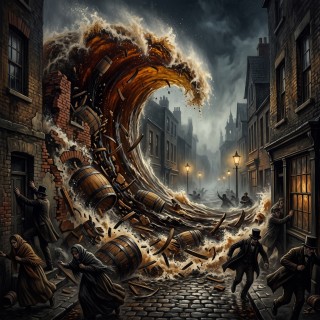
The initial explosion created an instant kinetic chain reaction. Flying timber and thousands of tons of escaping liquid violently smashed into neighboring vats, tearing several more open. In a matter of seconds, over 320,000 gallons of dark, foaming porter erupted into the brewery courtyard. The boiling surge formed a 15-foot-high wall of dark liquid, barreling through the brewery’s thick brick perimeter wall like paper and collapsing it instantly into the crowded streets outside.
The black tidal wave surged into New Street with terrifying ferocity. The slum’s architecture, consisting of poorly maintained, rotting multi-story brick tenements, stood no chance against the hydraulic hammer of hundreds of tons of liquid and debris. The wave tore the facades straight off two houses and completely obliterated the Tavistock Arms pub, crushing teenage barmaid Eleanor Cooper beneath the falling masonry.
The real horror, however, took place beneath street level. St. Giles was riddled with damp basement dwellings where entire impoverished families lived packed into single rooms. In one of these cellars on New Street, an Irish family had gathered for the wake of a two-year-old boy named John Saville. As mourners gathered around the small casket, the wall of beer shattered the basement windows, instantly filling the submerged room with drowning torrents of dark porter and splintered brick. Ann Saville, the boy’s mother, and four other mourners were swept into the murky darkness and drowned before they could reach the street stairs.
Outside, the scene was one of bewildering chaos. A thick, pungent mist of fermented malt and dust blanketed the neighborhood. Screams echoed through the alleys as survivors clambered through chest-deep, frothing brown mud to dig out neighbors pinned beneath collapsed timbers. In total, eight people lost their lives that evening, all of them women and children. Rumors later emerged in sensationalist tabloids that mobs of locals gathered with pots and kettles to binge-drink the beer running through the gutters, but contemporary reports paint a far more somber reality: the neighborhood was in shock, desperately searching the filth for their loved ones in near-silence.
In the aftermath, the legal system showed its traditional indifference to the plight of the urban poor. During the coroner’s inquest, the jury examined the brewery’s shattered vats and heard testimony from engineers. Astoundingly, the disaster was ruled an ‘Act of God,’ completely absolving Meux & Co. of negligence and denying the grieving families any financial compensation. To add insult to tragedy, Meux & Co. successfully petitioned the British Parliament for a waiver on the excise duties they had already paid on the lost beer, recovering thousands of pounds from the government.
Nevertheless, the catastrophe forever changed industrial brewing. The horror of the London Beer Flood sounded the death knell for massive, bound wooden fermentation vats. British breweries systematically dismantled their wooden giants, replacing them with secure, lined masonry and iron tanks, ensuring that a tidal wave of porter would never again wash through the streets of London.