No transcript available for this episode.
S01:E106
The Unsinkable Spirit: Wilhelm Bauer and the Birth of the Submarine
In the annals of invention, there are figures whose brilliance is overshadowed only by their audacious spirit and sheer refusal to be defeated. Wilhelm Bauer, a Bavarian artillery corporal with no formal training in naval architecture, was one such man. Born in 1822, Bauer possessed an unyielding vision: a submersible vessel capable of stealthily approaching enemy ships. This was the mid-19th century, an era dominated by towering battleships and sail, and the very concept of underwater warfare was considered the stuff of science fiction.
Bauer’s journey began not in a well-funded shipyard, but on the battlefields of the First Schleswig War (1848-1851). Witnessing the futility of conventional naval tactics against Danish blockades, he conceived of an underwater ‘diving boat’ – a revolutionary idea for the time. He painstakingly crafted models from wood and wire, demonstrating their potential to skeptical military officials. His initial designs were met with derision, his lack of academic credentials a significant hurdle. Undeterred, Bauer continued to refine his ideas, securing a patent and eventually gaining the support of the Kingdom of Bavaria. Their enthusiasm, however, did not translate into significant financial backing, leaving Bauer largely to his own devices.
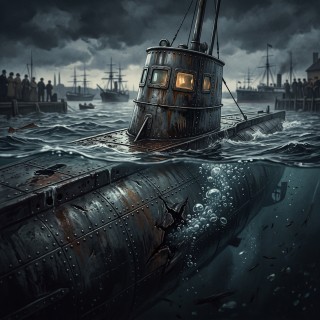
The year 1850 saw the construction of his first full-scale submarine, the ‘Brandtaucher’ (Fire-Diver). Built in Kiel, then part of Denmark, this crude iron vessel was a marvel of ingenuity and improvisation. It was hand-cranked, designed for two crew members, and armed with a retractable explosive charge. The Brandtaucher was a bold experiment, a testament to Bauer’s engineering prowess and an even greater testament to his bravery.
The fateful day arrived on February 1, 1851. During a demonstration in Kiel Harbor, with Bauer himself at the helm and two other crew members, disaster struck. The Brandtaucher suffered a catastrophic breach. Whether due to a design flaw, structural weakness, or a miscalculation in ballast, the submarine rapidly filled with water and plunged to the bottom of the harbor, coming to rest at a depth of about 60 feet. For most, this would have been the end. But Wilhelm Bauer was no ordinary man.
Trapped in the sinking vessel, facing imminent death, Bauer’s quick thinking saved his life and the lives of his crew. He understood the principle of air pressure. As the submarine descended, the air inside was compressed, creating a pressure differential with the water outside. Bauer calmly instructed his men to open the main hatch, knowing that the internal air pressure, though agonizing, would eventually equalize with the external water pressure, allowing the water to rush in and, critically, push the air bubble out through the hatch. This was a terrifying, counter-intuitive maneuver: intentionally flooding the vessel further to escape. It took over six harrowing hours for the water to completely fill the submarine, slowly compressing the air within. When the pressure finally equalized, the hatch could be opened, and the three men, battered but alive, were able to swim to the surface, escaping a watery tomb that had claimed countless lives in subsequent maritime disasters.
The Brandtaucher was eventually salvaged, but the incident deeply impacted Bauer’s reputation and financial prospects. Despite this setback, his unwavering belief in underwater navigation persisted. He went on to design and oversee the construction of the ‘Seeteufel’ (Sea Devil) for Russia in 1855, a more advanced vessel with improved controls and a more robust design. This submarine performed numerous successful dives, including a remarkable feat of submerging and resurfacing under the ice during the Crimean War, and even conducting a demonstration with members of the Imperial Court on board. Yet, despite these successes, operational issues and a lack of sustained interest from the Russian Admiralty ultimately led to its abandonment.
Wilhelm Bauer, the eccentric inventor who survived his own invention’s watery demise, never achieved the widespread recognition or lasting financial success of other pioneers. He died in 1875, his vision largely unrealized in his lifetime. However, his daring experiments, his brilliant escape from the Brandtaucher, and his pioneering work laid crucial groundwork for future submarine development. He proved that sustained underwater navigation was possible and, perhaps more importantly, that the human spirit, even in the face of insurmountable odds, can find a way to survive and innovate. Bauer wasn’t just a designer; he was a survivor, a testament to the indomitable will of an inventor ahead of his time.