S01:E87
The Voynich Manuscript: An Unbreakable Code from the Past
Nestled in the rare book collection of Yale University’s Beinecke Library lies one of history’s most enduring and perplexing enigmas: the Voynich Manuscript. For centuries, this heavily illustrated, parchment codex has defied every attempt at decipherment, its pages a tantalizing tapestry of botanical drawings unlike any known species, astronomical charts that don’t align with observed stellar patterns, and bizarre, anthropomorphic figures engaging in cryptic rituals. Written in an entirely unknown script, the Voynich Manuscript stands as a monumental challenge to cryptographers, linguists, and historians alike, a silent testament to a knowledge lost or perhaps deliberately obscured.
Its origins are as murky as its contents. Carbon dating places the parchment’s creation to the early 15th century, sometime between 1404 and 1438, firmly situating it in the late medieval or early Renaissance period. Its provenance, however, is a dizzying journey through the hands of emperors, alchemists, and scholars. Emperor Rudolf II of Bohemia, known for his obsession with esoterica, acquired the manuscript in the late 16th century, reportedly paying a hefty sum. From there, it passed through a succession of prominent figures, including the alchemist Georg Baresch and the scholar Athanasius Kircher, each of whom tried and failed to unlock its secrets. It was ultimately rediscovered in 1912 by Polish book dealer Wilfrid Voynich, after whom it is now named, hidden away in a chest in Villa Mondragone, Italy.
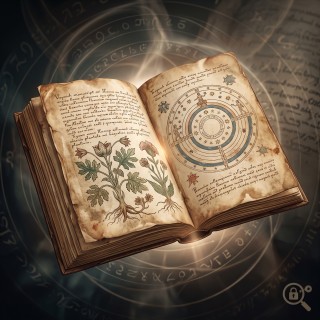
The manuscript itself is a marvel of medieval craftsmanship. Comprising around 240 vellum pages, though some are missing, it is a compact book, roughly 15 by 22.5 centimeters. Its most striking feature, beyond the indecipherable text, is its lavish and often surreal illustrations. These images are categorized into distinct sections: ‘Herbal,’ depicting fantastical plants with intricate root systems and vibrant flowers; ‘Astronomical,’ featuring celestial diagrams, zodiacal wheels, and what appear to be cosmological maps; ‘Biological,’ showcasing nude female figures bathing in green liquid and connected by intricate plumbing systems; ‘Cosmological,’ with folded pages revealing sprawling, multi-page diagrams; and ‘Pharmaceutical,’ illustrating individual plant parts and what might be apothecary jars.
The language itself is the manuscript’s greatest barrier. It consists of a unique alphabet, estimated to contain between 20 and 30 distinct characters, some of which bear a superficial resemblance to Latin or Greek letters, yet form no recognizable patterns when analyzed. Statistical linguistic analyses have shown intriguing regularities, suggesting it is indeed a language and not merely a random sequence of symbols. It exhibits characteristics typical of natural languages, such as recurring word patterns and a consistent word length distribution, but completely lacks any known grammar or vocabulary. Theories abound: is it an artificially constructed language, a cipher of an existing language, a hoax, or even a transcription of a lost tongue? Each hypothesis presents its own set of complexities and has yet to yield a definitive breakthrough.
Cryptographers, both amateur and professional, have dedicated their lives to cracking the Voynich code. From the codebreakers of World War I and II, who honed their skills on far more conventional ciphers, to modern computational linguists employing sophisticated algorithms and AI, the manuscript has resisted every assault. The challenges are immense. Without a known key, a parallel text, or even a clear understanding of the script’s underlying structure, it’s akin to solving a puzzle where the pieces themselves are unknown. Some theorize it’s a steganographic message, where the true meaning is hidden within the visual arrangement rather than the text itself. Others suggest it’s a practical joke, a brilliantly executed medieval hoax designed to fool erudite scholars.
The enduring mystery of the Voynich Manuscript is not just about the text itself, but what it represents. It’s a window into an unknown mind, a lost culture, or perhaps a hidden society. Its pages whisper of forgotten knowledge, of scientific observations beyond the understanding of its time, or of philosophical concepts alien to our own. Until a definitive breakthrough occurs, the Voynich Manuscript remains a powerful symbol of human curiosity and intellectual persistence, an unbreakable code from the past, forever challenging us to unravel its secrets and understand the story it desperately wants to tell.