0:00Intro
The War of the Currents: The Ruthless, High-Stakes Battle to Power the Modern World
Imagine a world teetering on the brink of an electrical revolution, a world where flickering gas lamps and steam engines were the norm, and the promise of widespread, affordable power was a distant dream. This was the late 19th century, and at its heart lay a battle more intense and impactful than any geopolitical conflict: The War of the Currents.
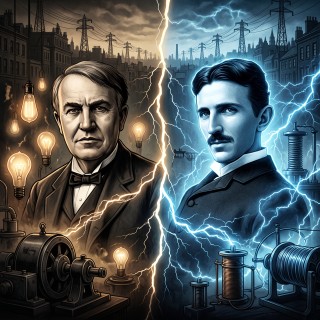
At one corner stood Thomas Edison, the “Wizard of Menlo Park,” a pragmatic genius and shrewd businessman, the proponent of direct current (DC). Edison’s DC system was the first to bring electricity to homes and businesses, illuminating Manhattan with its incandescent bulbs. It was a technological marvel for its time, but it had a significant flaw: DC could not travel long distances without substantial power loss. This meant that for every few blocks, a new power station was needed, making widespread adoption cumbersome and expensive.
In the opposing corner, a figure of ethereal brilliance, a visionary from the future: Nikola Tesla. A former employee of Edison’s, Tesla held a profound conviction in the superiority of alternating current (AC). AC, unlike DC, could be transformed to very high voltages for efficient long-distance transmission and then stepped down for safe use in homes and factories. Tesla’s AC system was elegant, scalable, and inherently more efficient for a nation on the cusp of industrial expansion.
The initial skirmishes were intellectual, debates over efficiency and safety. But as the stakes grew, so did the ferocity of the battle. Edison, fiercely protective of his DC empire and substantial investments, launched a ruthless smear campaign against AC. He painted AC as inherently dangerous, a “death current” capable of electrocuting unsuspecting citizens. He publicly electrocuted animals, including a notorious elephant named Topsy, using AC to demonstrate its supposed lethality. He even secretly funded the invention of the electric chair, ensuring it used AC to further demonize his rival’s technology, forever linking it with violent death.
Tesla, a man more comfortable with equations than public relations, struggled to counter Edison’s aggressive tactics. His primary champion became George Westinghouse, an industrialist who saw the immense potential of AC and was willing to invest heavily in its development and deployment. Westinghouse and Tesla faced immense pressure and financial strain from Edison’s relentless assaults.
The climax of this electrifying drama arrived at the 1893 World’s Columbian Exposition in Chicago. This was the moment of truth. Westinghouse, leveraging Tesla’s AC patents, won the bid to illuminate the entire fair, beating out Edison’s General Electric. The “City of Light” shone brightly, a dazzling testament to AC’s power and efficiency. Millions witnessed the spectacle, and the public’s perception began to shift.
Yet, the war was far from over. Edison continued his campaign, but the tide was turning. The sheer practicality and economic advantages of AC were undeniable. The construction of the Niagara Falls hydroelectric plant, harnessing the immense power of the waterfall to generate AC electricity and transmit it across long distances, was the definitive nail in DC’s coffin for widespread grid application.
Why did Edison fight so hard against something so demonstrably superior? Was it purely about ego, or was it a calculated business decision to protect his existing infrastructure and investments? And what does this epic struggle tell us about innovation, competition, and the often-unscrupulous nature of technological advancement?
The War of the Currents wasn’t just a battle between two brilliant minds; it was a foundational moment that shaped the modern world. It determined how our cities are powered, how our industries operate, and how our homes are illuminated. While Edison is remembered for his light bulb and countless inventions, it was Tesla’s vision, championed by Westinghouse, that truly brought the power grid into being, a silent, pervasive force that underpins our very civilization. The legacy of this brutal, high-stakes conflict lives on every time you flip a light switch, a testament to the ingenuity, ambition, and sometimes, the dark side of human progress.