No transcript available for this episode.
S01:E69
The War of the Golden Stool: The Blasphemy That Ignited an Empire
On a sweltering morning on March 28, 1900, inside the royal city of Kumasi, the British Governor of the Gold Coast, Sir Frederick Hodgson, committed one of the most disastrous diplomatic blunders in imperial history. Addressing an assembly of Ashanti kings, queen mothers, and military chieftains, Hodgson was blinded by the hubris of the British Empire. He demanded unpaid war reparations, rebuked the assembled royalty, and then uttered words that sucked the air straight out of the courtyard: ‘Where is the Golden Stool? Why am I not sitting on the Golden Stool at this moment? I am the representative of the Paramount Power. Why have you not given me the Golden Stool to sit upon?’
To Hodgson, the object was merely a regal chair—a physical trophy of conquest symbolizing submission to Queen Victoria. To the Ashanti, Hodgson had just threatened to extinguish their very existence.
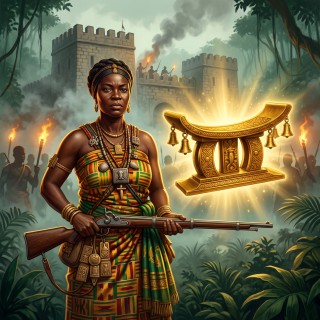
The Sika Dwa Kofi, or the Golden Stool, was never an ordinary piece of furniture. According to sacred tradition, it had descended from the heavens amidst thunder and lightning in the late seventeenth century, gently coming to rest on the knees of King Osei Tutu I through the invocations of the legendary high priest Okomfo Anokye. It did not belong to any human king, nor did it touch the bare earth. It was rested upon its own carved stand or an animal pelt, tilted so no wandering spirit might sit on it. Most profoundly, it was believed to house the ‘sunsum’—the collective soul, spirit, and survival of the entire Ashanti nation. Not even the Asantehene, the supreme monarch, ever sat upon it; he merely hovered over it during his coronation. For a foreign conqueror to demand to plant his backside upon the soul of their civilization was an intolerable sacrilege.
The assembly listened in stony, horrified silence, but their fury was incandescent. That evening, the chiefs gathered secretly to deliberate their next move. The situation seemed grim: the British possessed devastating Maxim machine guns, and the beloved Asantehene, Prempeh I, had already been deposed and exiled to the remote Seychelles islands. Paralyzed by fear and division, several chiefs argued that open war against the British would be suicide.
Then, a lone woman rose. It was Nana Yaa Asantewaa, the elderly yet formidable Queen Mother of Ejisu. Shaking with indignation, she looked across the room of hesitant men and delivered an address that would echo through African history: ‘How can a proud people sit back and see their kings taken away into exile, while you pay tribute to foreigners? If you, the men of Ashanti, will not go forward, then we will. We, the women, will fight! I shall call upon my fellow women. We will fight the white men! We will fight until the last of us falls on the battlefield!’
Yaa Asantewaa seized a rifle, and the male leaders, stung to their cores by shame and galvanized by her fierce resolve, took sacred oaths to wage total war. Nana Yaa Asantewaa was appointed war leader and commander-in-chief, an unprecedented honor.
Within days, thousands of Ashanti warriors emerged from the dense rainforests. They laid siege to the British fort at Kumasi, trapping Hodgson, his wife, a handful of British officers, and several hundred colonial soldiers behind stone walls. The British found themselves completely cut off from the outside world. Weeks turned into agonizing months. Inside the fort, provisions vanished; the garrison was reduced to eating rats, leather, and weeds, while tropical dysentery, smallpox, and malaria ravaged the defenders. Outside, snipers and stockades of solid timber neutralized British firepower.
Hodgson and a small, desperate contingent managed a harrowing escape through the jungle lines under cover of night in June, leaving a tiny garrison to hold the fort. It was not until July 1900 that a formidable British relief column—bolstered by the West African Frontier Force, Nigerian soldiers, and Sikh regiments under Colonel James Willcocks—finally broke the siege with heavy artillery and relentless counter-offensives.
The rebellion was brutally suppressed by the autumn of 1900. Kumasi was burned, and Yaa Asantewaa, along with her generals, was eventually captured and sent into exile in the Seychelles, where she died in 1921. On paper, the British annexed the Ashanti lands into their crown colony. Yet, history tells a different victor’s tale: the British never found, touched, or sat on the Golden Stool. Deep in the heart of the jungle, hidden by royal custodians, the sacred relic remained untouched. In preserving the stool, the Ashanti preserved their soul, ultimately living to see their royal kingdom restored within a free Ghana.