S01:E88
The Year Without a Summer (1816): When Darkness Fell and Monsters Awoke
Imagine a year where summer never truly arrived. A year where crops withered under an unseasonable chill, skies glowed with an eerie, persistent twilight, and the very air tasted of ash. This wasn’t a scene from a dystopian novel; it was the chilling reality of 1816, a year etched into history as ‘The Year Without a Summer,’ a global catastrophe triggered by an event thousands of miles away: the cataclysmic eruption of Mount Tambora in Indonesia.
On April 10, 1815, Mount Tambora, a colossal stratovolcano on the island of Sumbawa, unleashed an eruption of unfathomable power. Rated a 7 on the Volcanic Explosivity Index (VEI), it was the largest volcanic eruption in recorded human history. It ejected an estimated 100 cubic kilometers of ash, pumice, and aerosols into the atmosphere, creating a column of fire and debris that soared over 40 kilometers high. The immediate impact was devastating, obliterating the island of Sumbawa and claiming an estimated 71,000 lives, either directly from the eruption or from subsequent starvation and disease. But Tambora’s destructive reach was far from localized.
The true global impact began to manifest in 1816. The immense volume of sulfur dioxide injected into the stratosphere reacted with water vapor to form sulfuric acid aerosols. These microscopic particles, suspended high above the Earth, acted like a colossal sunshade, reflecting sunlight back into space. The result was a dramatic and widespread cooling effect across the Northern Hemisphere, particularly in North America and Europe. Average global temperatures plummeted by as much as 0.7 degrees Celsius, a seemingly small drop that had cataclysmic consequences.
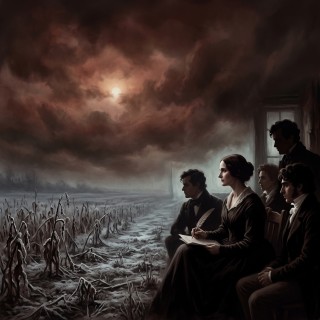
In New England, June saw snowfalls and killing frosts. Farmers watched in despair as their nascent crops succumbed to the relentless cold. July brought little relief, with temperatures remaining unseasonably low and skies often overcast or tinged with a reddish-brown hue from the lingering aerosols. August was no better; reports from across the globe painted a grim picture of widespread crop failures – wheat, corn, and oats simply would not grow. Livestock, deprived of fodder, perished in vast numbers. This unprecedented agricultural collapse triggered a global famine. Food prices skyrocketed, leading to widespread poverty, social unrest, and mass migrations as people desperately sought sustenance. Riots over food scarcity erupted in France and Switzerland, and desperate families abandoned their farms in search of better prospects.
Yet, from this crucible of despair and darkness, an unexpected spark of creativity ignited. In the summer of 1816, a group of young, intellectually vibrant individuals gathered at the Villa Diodati on the shores of Lake Geneva, Switzerland. Among them were the poet Lord Byron, his personal physician John Polidori, and the then-nineteen-year-old Mary Shelley, accompanied by her future husband, Percy Bysshe Shelley. They had anticipated a glorious, sun-drenched European summer, but instead found themselves trapped indoors by incessant rain, gloom, and unseasonably cold weather – a direct consequence of Tambora’s atmospheric veil.
To pass the time, Byron proposed a ghost story competition. Each member of the group was challenged to write a terrifying tale. It was under these bleak and oppressive conditions, fueled by the encroaching darkness and the chilling uncertainties of a world seemingly turned upside down, that Mary Shelley conceived the idea for her enduring masterpiece, ‘Frankenstein; or, The Modern Prometheus.’ Her tale of a reanimated corpse, brought to life through scientific hubris and abandoned to a world that reviled it, resonated deeply with the anxieties of the time. The very atmosphere outside, a world out of balance, provided a potent backdrop for her gothic horror.
John Polidori, inspired by Byron, also penned ‘The Vampyre,’ a seminal work that is considered one of the first modern vampire stories, establishing many of the tropes that would define the genre. Thus, the ‘Year Without a Summer,’ born from a colossal volcanic eruption, not only reshaped global climate and societies but also inadvertently birthed two foundational works of horror literature, forever altering the landscape of our collective imagination.
Mount Tambora’s eruption stands as a stark reminder of the immense power of nature and the interconnectedness of our global climate systems. It demonstrates how a single, dramatic event can cascade through environmental, social, and even cultural spheres, leaving an indelible mark on history and shaping the narratives we tell ourselves about humanity’s place in the world.