S01:E07
Thunder on the Plains: The Battle of the Little Bighorn
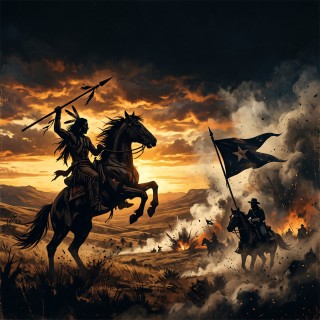
Imagine standing on a dusty hill in Montana. The sun is blazing, the air is thick with heat, and suddenly, the ground begins to shake. A low rumble grows into a deafening roar as thousands of hooves stampede across the prairie. Swirling clouds of dust fill the sky, and through the haze, you see the flashes of brass buttons and the bright feathers of Native American war bonnets. This is June 25, 1876, and you are standing at the center of one of the most famous, dramatic, and tragic clashes in American history: the Battle of the Little Bighorn.
To understand why this battle happened, we have to travel back to a time when the American West was changing rapidly. For centuries, Native American tribes like the Lakota Sioux, Cheyenne, and Arapaho had lived on the Great Plains, hunting buffalo and living in harmony with the land. But by the 1870s, the United States government was expanding westward. Settlers, railroads, and gold miners were moving onto native lands. A treaty had promised the Black Hills—a sacred area to the Lakota—to the Native Americans forever. However, when gold was discovered there in 1874, the promise was instantly broken. Thousands of white miners flooded the hills, and the US government ordered all Native Americans to move onto reservations. Many refused. They gathered along the winding Little Bighorn River, determined to protect their families and their way of life.
At the heart of the Native American alliance was Sitting Bull, a deeply respected holy man and chief. Before the battle, Sitting Bull performed a sacred sun dance. During this ritual, he had a powerful vision: he saw soldiers falling from the sky like grasshoppers, landing upside down in the Indian camp. This vision gave the warriors immense courage. Leading the fighters on the field was Crazy Horse, a legendary warrior known for his fearlessness, tactical genius, and his ability to charge into battle without ever being hit by a bullet.
On the other side was Lt. Colonel George Armstrong Custer, the commander of the US Seventh Cavalry. Custer was a national hero from the Civil War, famous for his golden curls, his red necktie, and his extreme daring. He was also highly ambitious. He wanted a grand victory that would make him even more famous. On that fateful June morning, Custer’s scouts warned him that the Native American encampment along the river was massive—perhaps the largest gathering of tribes the Plains had ever seen, with over 2,000 warriors. But Custer was overconfident. He believed his 600 soldiers, armed with superior training, could easily defeat any force. Fearing the camp would scatter and escape, he decided to attack immediately, making a fatal mistake: he split his regiment into three smaller groups.
Major Marcus Reno was ordered to attack the southern end of the camp, while Captain Frederick Benteen searched for escaping enemies. Custer took a force of about 210 men and rode along the bluffs to attack from the north. But the plan fell apart almost instantly. When Major Reno charged, he was met not by fleeing families, but by hundreds of furious warriors. Outnumbered and overwhelmed, Reno’s men retreated in a panic into the woods and up a steep hill, where they were pinned down.
Meanwhile, Custer and his men were completely cut off. Crazy Horse and his warriors swarmed over the ridges, using the hills for cover. Unlike the movie myth that Native Americans only fought with bows and arrows, many of the warriors were armed with rapid-fire repeating rifles, while Custer’s men had single-shot carbines that easily jammed. Surrounded, outnumbered, and blinded by smoke and dust, Custer’s men realized there was no escape. They shot their own horses to use as makeshift barricades, but it was hopeless. In less than an hour, Custer and every single one of his 210 men were killed. It became known as ‘Custer’s Last Stand.’
When the news reached the rest of the United States, just as the nation was celebrating its 100th birthday, the country was in absolute shock. The defeat of the famous Seventh Cavalry was unbelievable to the public. In response, the US government sent massive military reinforcements to the West. Within a year, the victorious tribes were hunted down, and most were forced onto reservations.
The Battle of the Little Bighorn—or the Battle of the Greasy Grass, as the Native Americans call it—was a spectacular victory for Sitting Bull and Crazy Horse, but it was also the beginning of the end for their free way of life. Today, the battlefield stands as a quiet monument to a time when two entirely different worlds collided on the wild, open plains of America.