No transcript available for this episode.
S01:E31
Unlocking the Cosmos: The Electric Genius of Albert Einstein
Imagine standing at the edge of human knowledge, looking out into a universe that no one before you has ever truly understood. At the turn of the twentieth century, physics was thought to be nearly complete. Scientists believed the universe ran like a giant, predictable clockwork machine governed by Isaac Newton’s laws. But a young, rebellious daydreamer with wild hair was about to shatter that illusion forever, reshaping our understanding of reality, time, space, and light.
Born in Ulm, Germany, in 1879, Albert Einstein was not the typical child prodigy. He was slow to speak, frustrated his teachers with his deep aversion to rote memorization, and routinely clashed with academic authority. Yet, his curiosity was insatiable. When his father showed him a simple pocket compass at age five, young Albert was mesmerized. How could an invisible force move a needle through empty space? That single moment sparked a lifelong obsession with the hidden mechanics of nature.
Failing to secure an academic teaching position after university, Einstein accepted a modest job as a third-class technical clerk at the Swiss Patent Office in Bern. To an outsider, it looked like a dead-end job. To Einstein, it was a sanctuary. While evaluating blueprints for electrical inventions during the day, his mind wandered into the profoundest mysteries of the universe. He engaged in vivid thought experiments—what he called Gedankenexperimente. He imagined riding alongside a beam of light, racing across space. What would the light wave look like?
In 1905, a period now revered as his Annus Mirabilis (Miracle Year), the twenty-six-year-old patent clerk published four groundbreaking papers in a single top-tier scientific journal. Any one of these papers would have established a brilliant career; together, they sparked a scientific revolution. First, he demonstrated that light consists of discrete packets of energy called photons, explaining the photoelectric effect and laying the groundwork for quantum physics. Second, he provided definitive proof of the existence of atoms by mathematically analyzing the jittery dance of microscopic particles in water (Brownian motion). Third, he introduced the Special Theory of Relativity, proposing that time and space are not absolute, but dynamic and relative to the speed of the observer. Finally, as a mathematical byproduct of relativity, he penned the most famous equation in history: $E = mc^2$. He showed that mass and energy are two forms of the exact same thing, revealing that even a tiny sliver of matter conceals enormous amounts of energy.
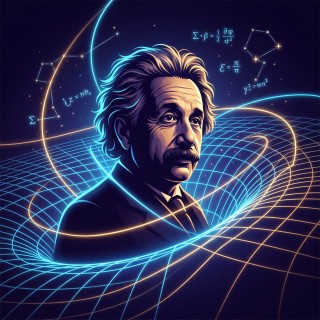
Yet, Einstein was not finished. For a decade, he wrestled with a glaring limitation in his special relativity: it did not account for gravity. In 1915, he unveiled his masterpiece: the General Theory of Relativity. Einstein boldly proposed that gravity is not a mysterious pulling force acting across distance, as Newton had taught, but rather a geometric warp in the fabric of four-dimensional spacetime. Heavy objects like stars and planets sink into this fabric, causing space to bend and time to slow down. The universe was not a stagnant stage; it was a flexible, pulsating cosmos.
In May 1919, during a total solar eclipse, British astronomer Sir Arthur Eddington measured the deflection of starlight passing near the sun. The predictions of General Relativity matched the experimental evidence perfectly. Overnight, Einstein became an international icon. Headlines proclaimed: “Lights All Askew in the Heavens—Einstein’s Theory Triumphs.”
Despite his rising fame, the world around him was darkening. As a Jewish intellectual and an outspoken pacifist in Germany during the 1930s, Einstein became a target of Nazi persecution. Forced into exile, he moved to the United States in 1933, taking a position at the Institute for Advanced Study in Princeton, New Jersey. Though a committed advocate for peace, Einstein signed a historic letter to U.S. President Franklin D. Roosevelt in 1939, warning that Nazi Germany might develop atomic weapons. This letter catalyzed the Manhattan Project, a decision that weighed heavily on Einstein’s conscience for the rest of his life.
In his final decades, Einstein stood as a giant of modern science, continuing to pursue an elusive “Unified Field Theory”—a single mathematical formula that could unite all fundamental forces of nature. Though that ultimate goal eluded him, his legacy remains monumental. From modern GPS navigation and lasers to solar panels and our understanding of black holes, the modern world is built on the foundations laid by Albert Einstein—the visionary clerk who dared to re-imagine the universe.