0:00Intro
Unraveling the Untold Crisis in Myanmar
On the morning of February 1, 2021, the world watched in shock as armored vehicles rolled into the streets of Naypyidaw, the vast, surreal capital of Myanmar. Dawn was breaking over the country’s majestic golden pagodas, but democracy was swiftly being shrouded in darkness. In a swift, calculated move, the military high command, known as the Tatmadaw, executed a coup d’état. They arrested State Counsellor Aung San Suu Kyi, President Win Myint, and hundreds of democratically elected lawmakers. Claiming baseless allegations of fraud in the November 2020 elections, General Min Aung Hlaing seized absolute control, crushing a fragile decade-long experiment with democratic governance. Yet, what the generals expected to be a swift takeover erupted into one of the most dynamic, complex, and fierce revolutionary movements of the 21st century.
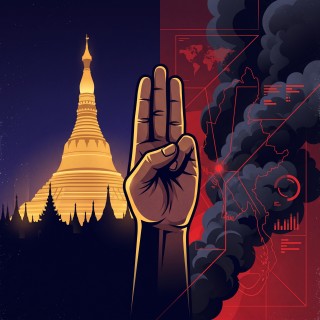
In the immediate aftermath, Myanmar’s citizens did not bow down. Instead, a wave of creative, non-violent resistance swept across the nation. Doctors left hospitals, teachers abandoned classrooms, and railway workers halted trains in a widespread Civil Disobedience Movement (CDM). Every evening at eight o’clock, the air in cities like Yangon and Mandalay vibrated with the deafening sound of millions banging pots and pans—a traditional ritual meant to drive out evil spirits. On the streets, Generation Z led massive rallies, brandishing the three-finger salute borrowed from the ‘Hunger Games’ as a symbol of defiance against tyranny. But the junta answered peace with brutal, lethal force, using snipers, live ammunition, and arbitrary detentions to crush public protests.
Faced with total repression, the resistance evolved rapidly. The peaceful demonstrators realized that moral superiority alone could not stop combat boots and rifle barrels. Thousands of young urbanites—programmers, poets, students, and engineers—fled into the dense, jungle-covered borderlands. There, they joined hands with Myanmar’s historic Ethnic Armed Organizations (EAOs), minority groups like the Karen, Kachin, and Shan, who had been fighting the military for decades to secure regional autonomy. Under the banner of the newly formed National Unity Government (NUG), a government-in-exile, these youths received crash courses in guerrilla warfare and formed the People’s Defense Forces (PDF).
What started as scattered civilian defense units eventually transformed into a sophisticated, nationwide armed struggle. By late 2023, the narrative shifted dramatically. In October 2023, an alliance of three powerful ethnic armies launched ‘Operation 1027’ in northern Shan State. The coordinated offensive dealt a devastating blow to the junta, overrunning hundreds of military outposts, capturing heavy weaponry, and securing key trade routes along the border with China. For the first time in modern history, the Tatmadaw—long considered an invincible, iron-fisted force—began to suffer humiliating defeats, losing vast swaths of territory and seeing thousands of its soldiers surrender or defect.
Yet, the human cost of this struggle remains staggering. Desperate to maintain power, the military regime has turned to terror tactics, conducting indiscriminate airstrikes on villages, schools, and hospitals, burning entire settlements to the ground, and causing a massive humanitarian catastrophe. More than 2.6 million people have been forced from their homes, creating a desperate refugee crisis across Southeast Asia. Meanwhile, the country’s economy has plunged into freefall, allowing lawless border regions to become hubs for cyber-scam syndicates and illicit trade.
Geopolitically, the crisis sits at a dangerous crossroad. While Western democracies have imposed strict sanctions on the junta, powers like Russia and China continue to provide weapons, aviation fuel, and diplomatic shield. Yet, China’s stance has become increasingly pragmatic, exasperated by the junta’s inability to maintain order or curb border crime.
What is happening in Myanmar today is not merely a distant political struggle; it is a profound battle for the soul of a nation. It is a story of unprecedented solidarity across ethnic lines, where a courageous population is risking everything to dismantle a military dictatorship once and for all. As the revolution rages on from the mountain passes to the central plains, the people of Myanmar continue to demonstrate an extraordinary truth: even against the heaviest armaments, the human thirst for freedom cannot be easily quenched.