
0:00Intro
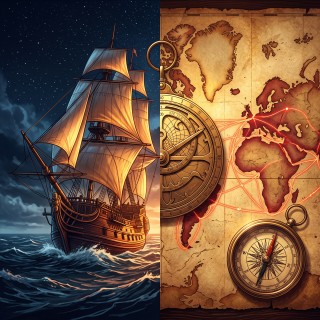
Winds of Empire: The High-Stakes Saga of the Age of Colonialism
Imagine standing on the docks of Lisbon or Seville in the late 15th century. The air smells of salt, oak timber, and pitch. Out on the horizon, massive wooden ships spread their canvas sails, preparing to venture beyond the edges of the known world. This was the dawn of the Age of Colonialism—an extraordinary, high-stakes era of history that reshaped the map of the Earth, redefined global commerce, and left a complex, often tragic legacy that still echoes across continents today.
For centuries, Europe sat at the western extremity of trade routes dominated by vast overland networks like the Silk Road. When the Ottoman Empire seized control of Constantinople in 1453, direct overland access to the riches of Asia—cinnamon, silk, pepper, and nutmeg—was effectively severed. Driven by an insatiable hunger for wealth, national prestige, and religious expansion, European monarchs funded daring maritime expeditions. Equipped with revolutionary technologies like the caravel ship, the magnetic compass, and the astrolabe, navigators sailed straight into the dark blue unknown.
Portugal led the charge, carving a sea route around the southern tip of Africa to India under Vasco da Gama. Meanwhile, Christopher Columbus, sailing under the Spanish flag in 1492, made landfall in the Americas, believing he had reached the East Indies. This unexpected encounter triggered the ‘Columbian Exchange’—a massive, unprecedented transfer of plants, animals, foods, and human populations between the Eastern and Western Hemispheres. European tables were suddenly graced with potatoes, tomatoes, and chocolate, while horses, wheat, and sugarcane reshaped the American landscape.
Yet, this era of discovery harbored a catastrophic dark side. The arrival of Spanish conquistadors like Hernán Cortés and Francisco Pizarro led to the brutal collapse of mighty empires such as the Aztecs and the Incas. Armed with steel weapons, horses, and gunpowder, the conquerors held a formidable military advantage. Far more devastating, however, were invisible killers: Old World diseases such as smallpox and measles, to which indigenous populations had no immunity. Millions perished within decades, decimating ancient cultures and leaving vast territories vulnerable to foreign domination.
As the 17th and 18th centuries unfolded, colonial competition escalated into a fierce global battleground. Powers like Britain, France, and the Netherlands created megacorporations with state-like authority—most notably the Dutch and British East India Companies. These corporate titans commanded private armies, minted their own coins, and enforced trade monopolies across Asia and the Caribbean. To fuel the insatiable European demand for plantation crops like sugar, tobacco, and cotton, a horrific system of human exploitation was established: the Transatlantic Slave Trade. Millions of African men, women, and children were forcibly torn from their homelands, surviving horrific ocean crossings to build the economic foundations of European empires under brutal conditions.
By the late 19th century, the Age of Colonialism reached its frantic climax during the ‘Scramble for Africa.’ Powered by the Industrial Revolution’s insatiable need for raw materials like rubber, copper, and oil, European powers met at the Berlin Conference of 1884–1885. Without a single African leader present, they drew arbitrary lines across a map of the continent, carving up ancient kingdoms into modern colonies.
The mid-20th century finally witnessed the retreat of formal European colonial empires through wave after wave of decolonization, spurred by indigenous liberation movements and the geopolitical ruin of the World Wars. Yet, the ghost of colonialism remains visible all around us. It lives in the modern global economy, the borders of nations, the spread of global languages, and ongoing struggles for social justice. The Age of Colonialism was not merely a chapter of conquest; it was the violent, chaotic forge that created our interconnected modern world.